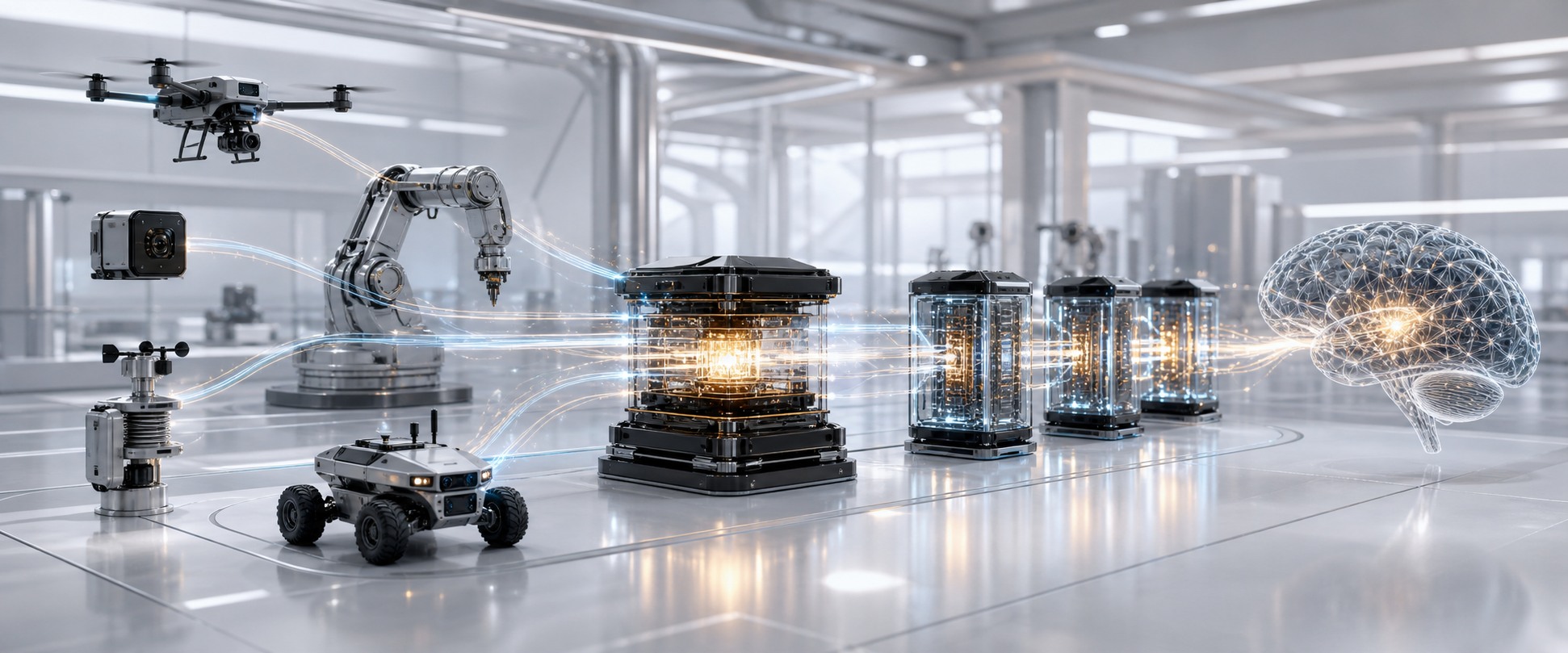
We connect expertise in AI, image recognition, VR, advanced manufacturing, international affairs and security, medical innovation and intellectual property, energy strategy, and mathematics and data science to the research, development and social implementation of the Physical AI Platform.
Osamu Hori - Doctor of Engineering
He joined Toshiba Corporation in 1986 and engaged mainly in the research and development of AI, including image processing and machine learning, at its Research and Development Center. He subsequently gained experience in corporate technology strategy planning and management auditing before serving as a department head and head of planning at the research center; in 2015, he became Director of the Corporate Research & Development Center. Over the course of his career, he was involved in the development and commercialization of numerous AI systems, including image recognition, facial image authentication, image compression, speech recognition and synthesis, machine translation, and autonomous driving. After taking charge in 2018 of the division overseeing company-wide research functions at Toshiba, he became a Corporate Officer in 2020 and also served in the highest-ranking technical expert role within the company. From 2022, as leader of the AI Center of Excellence (AI-CoE) Project, he led AI activities and AI governance across the Toshiba Group. He retired from Toshiba in March 2025 and was appointed Technical Advisor to Standard Link in June 2026.
Hiroo Iwata - Professor / Technical Advisor
Professor Hiroo Iwata of the Faculty of Data Science at Musashino University conducted pioneering virtual reality (VR) research at the University of Tsukuba from 1986 to 2023, leading original work in haptics, locomotion interfaces, projection-based VR, and motion bases. These achievements have been highly recognized in Japan and internationally. His contributions span the foundational theory of VR technology, applied design, and implementation through industry-academia collaboration, and have materially advanced the field. At Musashino University, he is developing the convergence of VR and AI and leading the Data Sensorium project, which aims to present the world of data as a human bodily experience. He received an Award for Science and Technology under the 2012 Commendation for Science and Technology by the Minister of Education, Culture, Sports, Science and Technology, and the 2025 IEEE VGTC Virtual Reality Lifetime Achievement Award. He served as President of the Virtual Reality Society of Japan from 2016 to 2020. With deep expertise in human informatics, mechatronics, and security, he brings exceptional insight to technology strategy planning.
Naohiko Sugita - Professor / Technical Advisor (excluding defense technology)
He joined the Graduate School of Engineering at The University of Tokyo in 2003 and was appointed Professor in 2014. He currently leads research at the forefront of manufacturing technology, including manufacturing engineering, machine tools, laser processing, and technologies for medical applications. His research spans precision machining of hard-brittle materials, machine-tool structures, ultrashort-pulse laser processing, and the development of medical devices, and he has served on numerous committees of academic societies and international conferences in Japan and abroad. He has held key positions in organizations including the Japan Society for Precision Engineering and the Japan Society of Mechanical Engineers, and is internationally recognized as a Fellow of CIRP, the International Academy for Production Engineering. He has published extensively in machine tools, laser processing, musculoskeletal models, and medical systems, and has received numerous honors, including the Mazak Foundation Excellent Paper Award, the Japan Society of Mechanical Engineers Medal for Outstanding Paper, and the Machine Tool Engineering Foundation Award. At Standard Link, he advises on technology and research and development in advanced manufacturing, precision machining, machine tools, laser processing, and medical engineering. His advisory scope excludes defense technology.
Fumiaki Kubo - Doctor of Laws / International Affairs Advisor / Professor Emeritus, The University of Tokyo / 10th President of the National Defense Academy of Japan (2021-2026)
Born in Tokyo, he graduated from the Faculty of Law at The University of Tokyo and received a Doctor of Laws degree from the university in 1989 for his work, New Deal and American Democracy. A specialist in American politics, he served as Lecturer and Associate Professor at the University of Tsukuba and as Associate Professor and Professor in the Faculty of Law at Keio University before becoming Professor at The University of Tokyo's Graduate Schools for Law and Politics in 2003. During this period, he conducted research at leading U.S. institutions including Cornell University, Johns Hopkins University, Georgetown University, and the University of Maryland, remaining at the forefront of research on Japanese and U.S. politics and diplomacy. He also held key posts including President of the Japanese Association for American Studies, member of the Subcommittee on Security of the Cabinet Office Committee on National Space Policy, and Senior Visiting Fellow at the Japan Institute of International Affairs. In April 2021, he became the 10th President of the National Defense Academy of Japan and, through March 2026, devoted himself to developing personnel responsible for national security and transforming defense education. He is now Professor Emeritus at The University of Tokyo. He has edited and authored numerous books, including The Tectonic Transformation of American Politics and An Analysis of the Trump Administration. Drawing on outstanding expertise in U.S. politics and diplomacy, Japan-U.S. relations, and security policy, he advises Standard Link on international affairs analysis and business strategy.
Yasumitsu Tomioka - Doctor of Medicine / Medical Innovation Advisor / Former Professor, Tokai University School of Medicine
After graduating from the Department of Mechanical Engineering, Faculty of Engineering, Keio University, he studied mechanical engineering at its graduate school and later graduated from the university's Department of Law. Bringing together technology and law, he handled Japanese and international patent applications at a major patent firm before establishing Office Tomioka independently in 1994. He has worked at the forefront of patent consulting for 30 years. During that period, he spent approximately ten years in medical research as a researcher in Emergency and Critical Care Medicine within the Department of Surgery at Tokai University School of Medicine, and subsequently served as lecturer, associate professor, and professor on a part-time basis. In 2011, he received a Doctor of Medicine degree for research on patent issues in medicine. His distinctive interdisciplinary background across engineering, law, and medicine means that he understands the entire innovation process: creating technology, protecting it through intellectual-property rights, and applying it in clinical settings. At the International Telecommunication Union (ITU), he twice served as vice-chair in work concerning ICT and persons with disabilities and ICT and the environment, contributing to international ICT standardization. He has also served as a visiting professor at Seisa University. Drawing on outstanding expertise at the intersection of medicine and AI, medicine and intellectual property, and medicine and ICT, he advises Standard Link on AI business development and intellectual-property strategy in the medical and healthcare fields.
Kazunori Nagai - Energy Strategy Advisor
At the Technical Development Bureau and other divisions of Nippon Steel Corporation, formerly Nippon Steel, he led process development and product industrialization as a section head and department head, working at the forefront of technology development in the materials industry. He later served as a department director and organizational head at the New Energy and Industrial Technology Development Organization (NEDO), where he oversaw the planning and advancement of national projects. Under Green IT, anticipating the explosive growth in energy demand accompanying the information society, he promoted the development of energy-saving technologies for data centers, addressing at an early stage a theme now essential to the AI and cloud era. Under Energy ITS, he led development that helped pave the way for today's autonomous-driving technologies and also advanced programs for innovative energy-efficiency technologies. Internationally, he served as a committee member of the International Energy Agency's Heat Pump Programme (HPP; now the Heat Pumping Technologies (HPT) Technology Collaboration Programme), and as a member and vice-chair of its Advanced Motor Fuels (AMF) Technology Collaboration Programme. He also served as a member of the Program Director Council for Competitive Funding Programs under the Council for Science, Technology and Innovation of the Cabinet Office. In education, he taught for many years as an adjunct and guest lecturer at institutions including Tokyo University of Science (DMS) and Waseda University (GSICCS).
Shigehide Iwata - Ph.D. in Science / Technical Advisor / Tokyo University of Marine Science and Technology
Dr. Shigehide Iwata serves as Assistant Professor at the Department of Marine Biosciences, Tokyo University of Marine Science and Technology, and remains at the forefront of research and education. His expertise spans mathematical ecology, applied mathematics, and statistics, and he elucidates complex biological and environmental systems through mathematical modeling combined with statistical and optimization methods. His theoretical work using lattice models to analyze competition and mutualism among species has been published in journals including Ecological Modelling. He has produced wide-ranging results in data-driven prediction and optimization, including the development of fish stock assessment methods and the underlying parameter estimation techniques, machine-learning-based estimation of abundance indices, mathematical modeling and optimization of material cycles in aquaponics, and risk diversification in multi-species fisheries through the application of portfolio theory. In 2023, he received the Best Paper Award of the Japanese Association for Coastal Zone Studies. He teaches Introduction to Data Science, Applied Statistics, and Bioresource Analysis, and is a contributing author to the Dictionary of Theoretical Biology (Asakura Publishing). His expertise in mathematics and data science—predicting and optimizing outcomes from limited data—contributes to advancing Standard Link's AI and image analysis technologies.
Takaaki Uemura - Juris Doctor / Master of Engineering / Technology Law Advisor / Patent Attorney / Administrative Scrivener / Former Japan Patent Office Examiner
Born in Asahikawa, Hokkaido, he studied mechanical engineering at Tokyo Institute of Technology and earned a Master of Engineering after specializing in nuclear engineering in its graduate school. At the Japan Patent Office, he served as an assistant examiner and examiner, examining industrial property rights and gaining an inside understanding of the examination philosophy used to assess technological novelty and inventive step. While still in government service, he attended the evening program at Omiya Law School and earned a Juris Doctor. With a foundation in engineering and a Juris Doctor—having pursued both scientific and humanistic disciplines and also being registered as a patent attorney and administrative scrivener—he is one of the rare interdisciplinary professionals in Japan who genuinely bridges technology and law. He has also contributed to the development of intellectual property jurisprudence, including presenting the theoretical framework known as ‘obviousness upon obviousness,’ which has been debated in relation to inventive-step determinations. For many years, he has continued educational and public-facing activities at the intersection of technology and law, including lectures at NEC and independent administrative agencies and a long-running column in Teikoku Databank’s Teikoku News. He brings a dual perspective grounded in an inside understanding of both the engineer’s logic and the lawyer’s logic. At Standard Link, drawing on expertise that spans engineering and law, he advises on matters at the intersection of technology and law arising from AI and advanced-technology businesses.